Tag: reading

  • Not reading ‘Mrs Death misses death’

    I’m currently struggling through Salena Godden’s Mrs Death misses death, which I am supposed to write a comparative essay on (comparing it to Ali Smith’s Hotel World) due in a week and I’m still only halfway through the book – which is good, by the way; the reason I am struggling to read it is not a reflection on its quality or even evidence of a mismatch between it and my tastes, quite the opposite, it is very much in line with my tastes – I had expected this book to be a dark comedic fictional biography of Death, and a existential exploration of mortality, with the concept of life and death as an element through which to contextualise humanity, but, although there is some of that through the character of Mrs Death and her musings, the majority of the book is focused on the narrator’s first person accounts, either in prose or poetry, of their suicidal ideation… Now, the last thing you need to be reading when you are yourself a bipolar writer with consistently recurring battles with suicidal ideation, currently fending off the tailend of seasonal depression, is a first person narrative about a bipolar writer with suicidal ideation fending off the tailend of seasonal depression… because you will start to question your own sanity. In fact, you’d be mad not to.

    Zooming out from this book, and my current predicament, for a moment. This is a real problem. Because suicidal ideation, suicidal thoughts and suicide are a serious problem. Whether you are actively suicidal, or a person struggling with suicidal ideation, or a person close to someone struggling with suicidal thoughts or, worse, a person who has lost someone to suicide, it is something that is as lonely as it is difficult to deal with. You need to talk to someone about it, but it is impossible to talk about. You need to try and understand it, to make sense of it, to name it so you can confront and fight it. But here is the rub… consuming media depicting themes of suicidal ideation, even when it’s not glamorised or romanticised, is known to exacerbate issues of suicidal ideation amongst those who struggle with it. Data shows that after a TV show with high viewing numbers has depicted scenes of this nature or generally deals with the theme of suicide (e.g. the Netflix show 13 reasons why) there is a recorded spike in both suicide hotline phone calls and actual attempts. But avoiding the topic altogether is also not the answer, because that adds to the social sigma and then this portion of the population who are struggling with thoughts of suicide are left to suffer in silence. I don’t know what the answer is, but I suppose responsible storytelling is the main thing. For example, Bradley Cooper’s film A star is born completely romanticises the main character’s suicide, which is completely irresponsible in my opinion, whereas the novel The Hours and its screen adaptation manages to toe the line in how it depicts the suicidal ideation and actual suicides of its respective central characters, even the suicide of Virginia Woolf herself, which is a feat, considering she made poetry out of her own suicide, lining her skirt with stones and walking into the rushing river.

    If I compare The Hours and Mrs Death misses death, it’s hard to put my finger on the difference – maybe it is as simple as one being written in close third person and the other in first? – but one allows me to reflect on the subject of suicide, and of life and death, and come out the other side with a stronger will to live, and the other one… doesn’t.

    However, my tutor assures me that the narrator ‘pulls through’ in the end, so I expect that is the way the story is heading. It is just taking its sweet time to get there, wallowing in the symptoms of manic depression and anxiety on the way, interspersed with Mrs Death’s accounts of various gruesome and violent deaths, including that of a child who was sexually assaulted, tortured and murdered by Ian Brady and Myra Hindley, so based on real events, which, after ages of Epstein files flooding my social media channels (until I logged off all of social media) has not been the most comforting of reads.

    And the problem with my brain is, it won’t turn off. So now I’m haunted by images of children being tortured, imaginary children or my own, on top of questioning my own sanity. So all in all, I have no idea how I’m going to get this essay done in time…
  • Thinking about folklore & traditions in the lead-up to Yule!

    Thinking about folklore & traditions in the lead-up to Yule!

    Following on from my previous blog post about reading Ali Smith for my university course, this week I’m onto reading Potiki by Māori author Patricia Grace, which incorporates a lot of the the indigenous storytelling traditions of the Māori. I’m loving it so far, and I love how it portrays this ‘different’ culture and its traditions unapologetically, peppering the text with Māori words without providing an English translation or even a glossary. In fact, I’ve just read about this in the textbook. Apparently, when asked about this by an interviewer once, the author replied, ‘I didn’t feel it should be necessary. I just felt that Māori people have never had glossaries given to them when things have been written in other languages that they’ve been led to read.’ And I just love that!

    Also, a major theme in the book is the relationship between the Māori people (represented by the cast of characters that the book is about) and the land, and I’m finding a lot of similarities between their folklore and that of my own nordic one.

    A lot of the inspiration for the fictitious people in Pack Animals and their traditions are rooted in Swedish/Nordic folklore and pagan traditions (nowadays intermingled with Christian influences. For example, the light celebration festival of the 13th of December, which was historically the start of the jul/yule festival culminating in a big feast on the winter solstice, is still celebrated in Sweden, only now it’s incorporated the Christian imagery of angels and a Saint – Santa Lucia – dedicated to the day, who represents the bearer of the light/hope. In Pack Animals, the fictitious demigods called díser have a light festival on December 13th, which more closely resemble the pagan festivities before Christianity came to the nordic region.)

    A lot of nordic folklore and old fables centre around the relationship between people and nature, and the more I read about folklore and mythologies from other parts of the world, the more I realise how that connection with nature was fundamental to all cultures originally, and how modern religion and capitalism with its industrialisation and globalisation has severed that bond between us and the natural world. I think that the disconnect between us humans and the rest of the world is the most destructive thing to have happened to our species, and probably the planet at large.

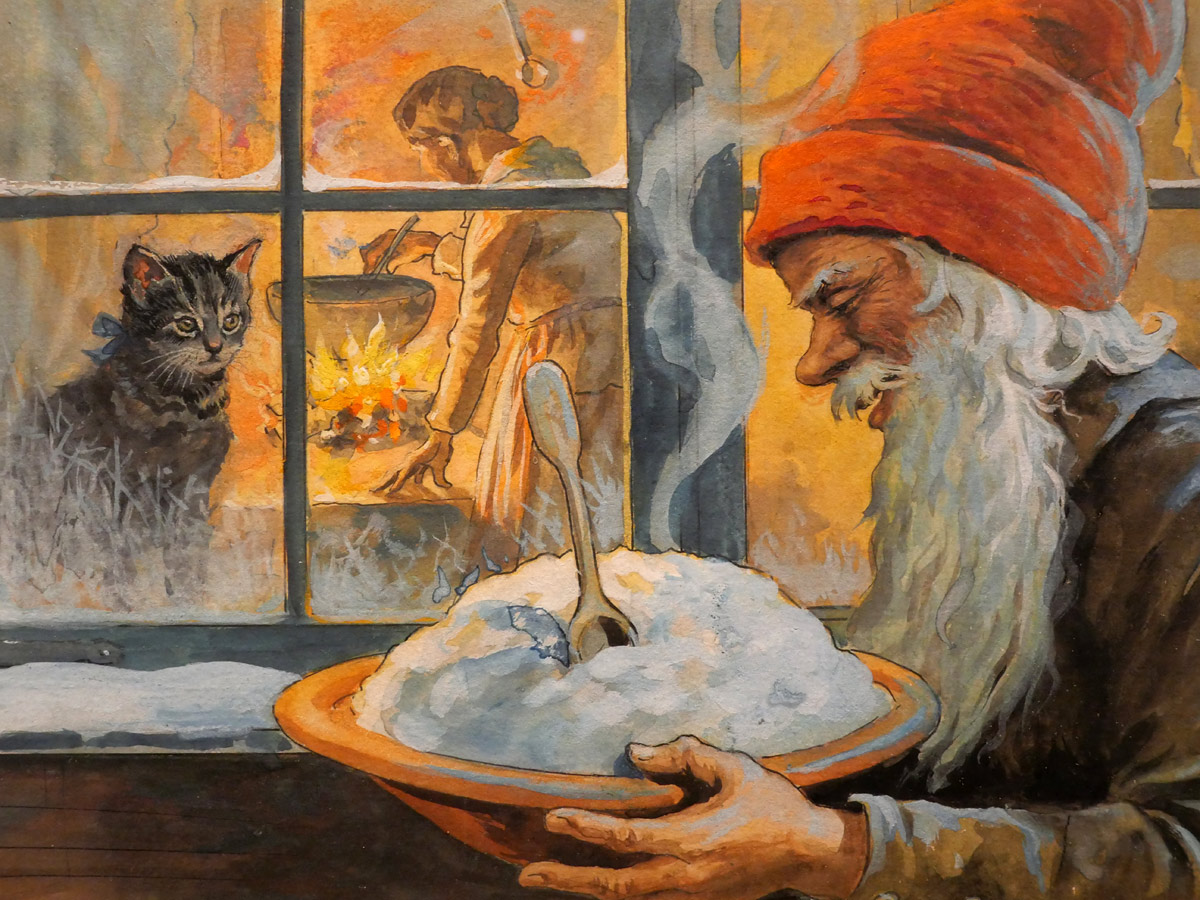
    One of the ‘silly’ yule traditions from my childhood was to put out a bowl of ‘yule porridge’ (which is essentially rice pudding seasoned with sugar, cinnamon and with a melting ‘butter eye’) for tomten. Now, in modern times there has been some confusion around who this Tomte is, because along with modern day American influences, the word tomte has also become the Swedish word for Santa, so nowadays children understandably believe they are leaving out a bowl of porridge for Santa, like children in the US leave out milk and cookies. However, this is not the case. The tradition of leaving out a bowl of porridge for tomten predates the Christian-Capitalist symbol of Santa Claus, and the creature we call a tomte is closer to what you might call an elf or a gnome (first depicted with the traditional red hat by illustrator Jenny Nyström, as seen in the cover picture of this blog post). Historically it was believed that lots of them lived in the woods, but that each household or farm had one designated tomte, essentially a house gnome invisible to most humans, especially adults, who looked after the animals throughout the year – and at yule, you offered the tomte who looked after your household a bowl of porridge to show your gratitude!

    And this is why I’m carrying on this tradition with my own two toddlers, because what better way to teach your children about the importance of taking care of nature, animals and the environment, and of showing empathy and gratitude, than through a playful but important holiday tradition during their formative years?

    Because think about it, which delivers a more meaningful message: bribing the corpulent symbol of capitalist consumerism so he’ll bring you lots of stuff, or giving thanks to a benevolent being who takes care of you, you animals and your environment throughout the year?

  • Reading Ali Smith

    Reading Ali Smith

    I am currently reading Ali Smith’s Hotel World for my English Literature degree. I love Ali Smith. She is one of my all-time favourite authors. I literally have one of her author portraits in a vision board-style collage as a wallpaper on my laptop. I think her Seasonal series is a work of pure genius, with Winter being my own personal favourite, which has consistently been in my top five books of all time ever since I read it. I don’t write literary fiction (at least not at the moment), but I aspire to be more like Ali Smith in my approach to and execution of storytelling, how she is so incredibly intelligent and knowledgeable, peppering her work with subtle references from all over the literary and pop culture landscape whilst also commanding incredible control of language and form, and she executes it all in a playful and multilayered way so it never once comes across as pretentious (at least in my opinion), only ever witty and entertaining.

    This is my first time reading Hotel World, and my first time analysing any of Ali Smith’s writing through a literature study lens and discussing it with other English Literature students, and I’m loving every moment of it.

    Her experimentation with narrative voice is particularly interesting. In Hotel World, for example, there is first person narration, close third person and omniscient third person, all mixed together in different sections following different characters who are all tied to this particular place and time, the Global Hotel and, intentionally, it is not always the character who is the focus of a particular section that tells their own story, and it got me thinking about the power of control of narrative in general, in media, in the public space, in the private space in all of our own lives; who tells your story?