Following on from my previous blog post about reading Ali Smith for my university course, this week I’m onto reading Potiki by Māori author Patricia Grace, which incorporates a lot of the the indigenous storytelling traditions of the Māori. I’m loving it so far, and I love how it portrays this ‘different’ culture and its traditions unapologetically, peppering the text with Māori words without providing an English translation or even a glossary. In fact, I’ve just read about this in the textbook. Apparently, when asked about this by an interviewer once, the author replied, ‘I didn’t feel it should be necessary. I just felt that Māori people have never had glossaries given to them when things have been written in other languages that they’ve been led to read.’ And I just love that!
Also, a major theme in the book is the relationship between the Māori people (represented by the cast of characters that the book is about) and the land, and I’m finding a lot of similarities between their folklore and that of my own nordic one.
A lot of the inspiration for the fictitious people in Pack Animals and their traditions are rooted in Swedish/Nordic folklore and pagan traditions (nowadays intermingled with Christian influences. For example, the light celebration festival of the 13th of December, which was historically the start of the jul/yule festival culminating in a big feast on the winter solstice, is still celebrated in Sweden, only now it’s incorporated the Christian imagery of angels and a Saint – Santa Lucia – dedicated to the day, who represents the bearer of the light/hope. In Pack Animals, the fictitious demigods called díser have a light festival on December 13th, which more closely resemble the pagan festivities before Christianity came to the nordic region.)
A lot of nordic folklore and old fables centre around the relationship between people and nature, and the more I read about folklore and mythologies from other parts of the world, the more I realise how that connection with nature was fundamental to all cultures originally, and how modern religion and capitalism with its industrialisation and globalisation has severed that bond between us and the natural world. I think that the disconnect between us humans and the rest of the world is the most destructive thing to have happened to our species, and probably the planet at large.
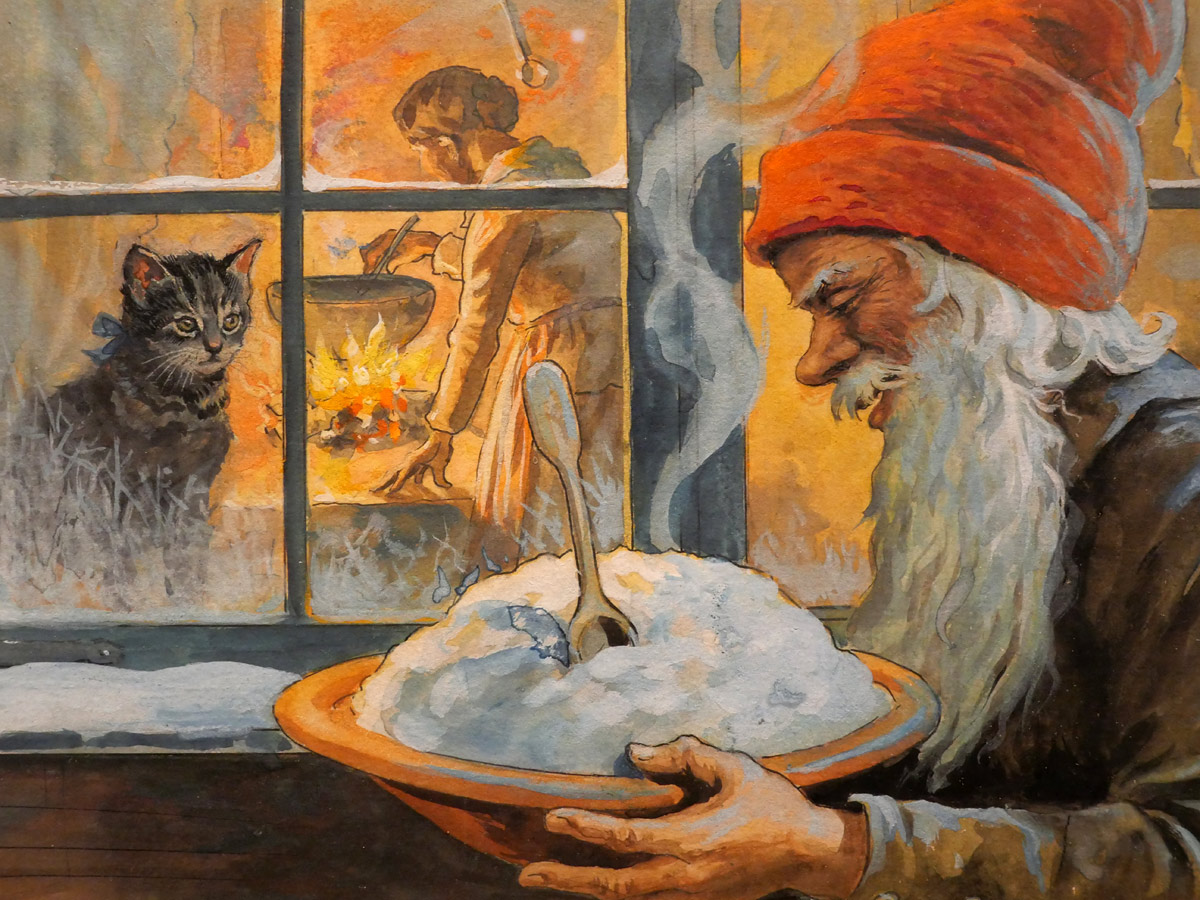
One of the ‘silly’ yule traditions from my childhood was to put out a bowl of ‘yule porridge’ (which is essentially rice pudding seasoned with sugar, cinnamon and with a melting ‘butter eye’) for tomten. Now, in modern times there has been some confusion around who this Tomte is, because along with modern day American influences, the word tomte has also become the Swedish word for Santa, so nowadays children understandably believe they are leaving out a bowl of porridge for Santa, like children in the US leave out milk and cookies. However, this is not the case. The tradition of leaving out a bowl of porridge for tomten predates the Christian-Capitalist symbol of Santa Claus, and the creature we call a tomte is closer to what you might call an elf or a gnome (first depicted with the traditional red hat by illustrator Jenny Nyström, as seen in the cover picture of this blog post). Historically it was believed that lots of them lived in the woods, but that each household or farm had one designated tomte, essentially a house gnome invisible to most humans, especially adults, who looked after the animals throughout the year – and at yule, you offered the tomte who looked after your household a bowl of porridge to show your gratitude!
And this is why I’m carrying on this tradition with my own two toddlers, because what better way to teach your children about the importance of taking care of nature, animals and the environment, and of showing empathy and gratitude, than through a playful but important holiday tradition during their formative years?
Because think about it, which delivers a more meaningful message: bribing the corpulent symbol of capitalist consumerism so he’ll bring you lots of stuff, or giving thanks to a benevolent being who takes care of you, you animals and your environment throughout the year?